Introduction
Across Nigeria today, thousands of residential buildings, commercial developments, roads, estates, plazas, hotels, schools, hospitals, and infrastructure projects are under construction. The construction and real estate sector continue to expand rapidly because of urbanization, population growth, investment opportunities, and the increasing demand for housing and infrastructure.
Yet despite this rapid growth, one painful reality continues to affect the industry: many building projects fail.
Some projects begin with excitement and ambition but eventually become abandoned structures. Others consume far more money than originally planned. Some projects suffer serious delays, while others develop dangerous structural defects shortly after completion. In severe situations, buildings collapse completely, destroying lives, investments, and reputations.
These failures do not happen by accident.
Most failed building projects are the result of poor planning, weak project management, unqualified contractors, substandard materials, financial mismanagement, lack of supervision, and ignorance of engineering principles.
Unfortunately, many property owners underestimate the complexity of construction. Some people assume that once they buy land and hire workers, the project will automatically progress smoothly. In reality, construction is one of the most technical and financially demanding industries in the world. Every successful building project depends on coordination, technical expertise, planning, engineering calculations, quality control, budgeting, supervision, and risk management.
The purpose of this article is to provide a deep understanding of why many construction projects fail in Nigeria and how developers, homeowners, investors, and contractors can avoid costly mistakes.
Lack of Proper Planning Is One of the Biggest Causes of Failure
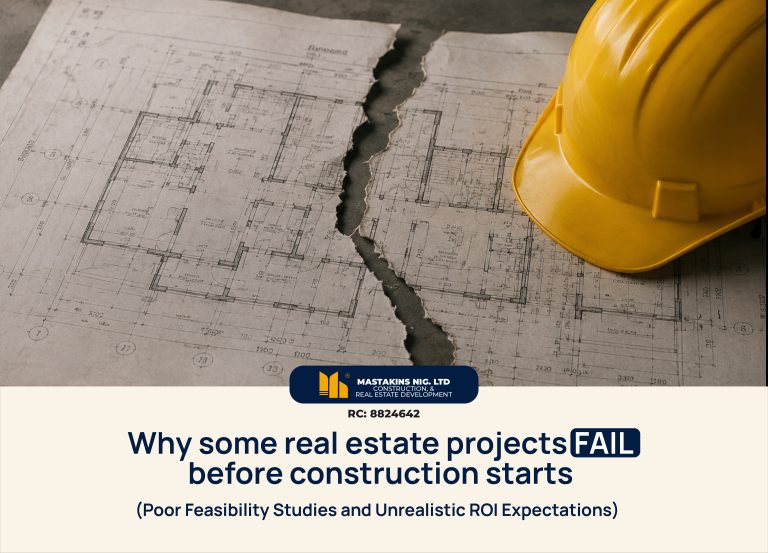
Many construction projects fail before the first block is even laid because there was no proper planning process.
Planning is the foundation of every successful project. Unfortunately, many people rush into construction emotionally without conducting feasibility studies, creating realistic budgets, analyzing risks, or consulting professionals.
Some property owners buy land and immediately begin construction without understanding:
- The total financial requirement
- The soil condition of the site
- The approval processes
- The complexity of the design
- The infrastructure requirements
- The project timeline
- Possible future risks
This lack of planning creates confusion from the beginning.
As construction progresses, problems begin to appear gradually. Material costs rise unexpectedly. Design changes become necessary midway. Contractors begin requesting additional money. Delays occur because activities were not scheduled properly. Eventually, the project becomes financially unstable.
A well-planned project usually includes:
- Detailed architectural drawings
- Structural engineering analysis
- Quantity surveying and cost estimation
- Construction scheduling
- Procurement planning
- Cash flow forecasting
- Risk assessment
- Regulatory approval planning
Without these systems, the project operates blindly.
One major problem in Nigeria is that many people start projects based purely on estimated assumptions rather than professional calculations. They may assume a project will cost ₦20 million simply because someone else built a similar structure years ago. However, differences in location, soil conditions, material prices, design complexity, labor rates, inflation, and finishing standards can dramatically change project costs.
Proper planning helps reduce uncertainty. It allows developers to understand what they are entering before major financial commitments are made.
Hiring Cheap or Unqualified Contractors Often Leads to Disaster
Another major reason building projects fail is the use of inexperienced or unqualified contractors.
In many situations, clients select contractors based primarily on price. The cheapest contractor is often awarded the project regardless of competence, technical knowledge, experience, or management capacity.
This decision may appear financially attractive initially, but it often becomes extremely expensive later.
Unqualified contractors may lack:
- Engineering knowledge
- Project management skills
- Quality control systems
- Skilled labor
- Financial discipline
- Proper supervision structures
- Understanding of building regulations
As a result, they may begin cutting corners to maximize profits.
Some common examples include:
- Reducing cement content in concrete
- Using weak reinforcement bars
- Employing unskilled laborers
- Ignoring engineering drawings
- Using poor-quality electrical materials
- Rushing construction processes improperly
The consequences are severe.
Buildings may develop cracks shortly after completion. Floors may become uneven. Water leakage problems may emerge. Electrical faults may increase fire risks. Structural instability may gradually develop over time.
In many cases, the client eventually spends far more correcting mistakes than they would have spent hiring competent professionals initially.
Professional contractors understand that construction is not merely about physical labor. It involves engineering coordination, procurement management, workforce supervision, safety compliance, technical execution, and quality assurance.
Before hiring any contractor, developers should verify:
- Previous completed projects
- Professional registration
- Technical capacity
- Company structure
- Client testimonials
- Financial capability
- Experience with similar projects
The cheapest option is rarely the safest option in construction.
Substandard Materials Continue to Destroy Building Quality
Material quality plays a critical role in determining the durability and safety of a building.
No matter how beautiful a building appears externally, weak construction materials can compromise the entire structure internally.
One of the most dangerous trends in the industry is the increasing circulation of fake or substandard materials.
Examples include:
- Weak reinforcement bars
- Low-quality cement
- Inferior electrical cables
- Poor roofing sheets
- Weak plumbing materials
- Substandard paints and finishes
- Poor-quality doors and windows
Many of these materials are cheaper alternatives introduced into the market to reduce costs.
Unfortunately, many property owners focus only on immediate savings without considering long-term consequences.
Substandard materials may initially appear similar to quality products, but their performance over time is drastically different.
For example, poor electrical cables may overheat and cause fire outbreaks. Weak reinforcement bars reduce structural strength. Inferior roofing materials may rust rapidly. Low-quality plumbing systems may leak repeatedly.
Material quality directly affects:
- Structural stability
- Durability
- Safety
- Maintenance cost
- Building lifespan
- Occupant comfort
Professional supervision and material testing are essential in preventing these issues.
Developers should always purchase materials from trusted suppliers and ensure proper inspection during delivery.
Ignoring Soil Testing Is a Serious Technical Mistake
Many people purchase land and immediately begin foundation work without conducting soil investigation.
This is extremely risky.
Different soils behave differently under structural loads. Some soils can support heavy buildings safely, while others may experience settlement, movement, erosion, or instability.
Without soil testing, engineers cannot accurately determine:
- The load-bearing capacity of the ground
- The water table level
- The suitable foundation system
- Potential settlement risks
- Soil stability conditions
This information is critical.
A building constructed on weak soil without proper foundation design may develop structural cracks or differential settlement over time.
Some areas in Nigeria are particularly vulnerable because of:
- Swampy terrain
- Expansive clay soils
- Flood-prone environments
- Erosion conditions
- High groundwater levels
Geotechnical investigation helps engineers design foundations that match site conditions.
Although some developers see soil testing as an unnecessary expense, it actually prevents future structural disasters and financial losses.
Skipping soil investigation to save money can eventually lead to foundation failure that costs millions to repair.
Poor Project Management Creates Confusion and Waste
Project management is one of the most underestimated aspects of construction.
Many people believe construction simply requires workers and materials. However, large and successful projects operate through organized systems.
Project management involves:
- Planning
- Coordination
- Scheduling
- Procurement
- Cost monitoring
- Team management
- Quality control
- Communication
- Risk management
Without proper project management, even technically sound projects may fail.
Common problems associated with poor project management include:
- Material shortages
- Delayed deliveries
- Budget overruns
- Rework
- Poor coordination between professionals
- Site confusion
- Labor inefficiency
- Low productivity
For example, if materials are not delivered at the right time, workers may remain idle while labor costs continue accumulating. If project activities are not coordinated properly, completed work may later be demolished because another system was forgotten.
Professional project managers help maintain organization and accountability throughout the project lifecycle.
They ensure that:
- Activities follow schedule
- Resources are allocated properly
- Costs are monitored continuously
- Risks are identified early
- Communication remains effective
Strong project management significantly improves the chances of successful project delivery.
Corruption and Financial Mismanagement Continue to Damage Projects
Corruption remains one of the major challenges affecting the construction industry.
In some projects, funds are diverted away from actual construction activities. Inflated contracts, material theft, false billing, bribery, and financial dishonesty create serious project instability.
Financial mismanagement can quickly destroy even well-designed projects.
Examples include:
- Contractors misusing mobilization funds
- Poor record keeping
- Uncontrolled spending
- Untracked procurement
- Lack of financial transparency
When project finances become unstable, construction slows down.
Contractors may begin using cheaper materials to compensate for financial shortages. Workers may remain unpaid. Suppliers may stop deliveries.
Eventually, project quality begins deteriorating.
Transparent financial systems are critical for construction success.
Developers should maintain:
- Clear budgets
- Procurement records
- Payment schedules
- Financial audits
- Material tracking systems
Financial discipline is just as important as engineering competence.
Poor Site Supervision Leads to Construction Defects
Even with good designs and quality materials, poor supervision can still destroy a project.
Construction sites require constant monitoring.
Without proper supervision, workers may:
- Ignore technical drawings
- Use incorrect dimensions
- Place reinforcement wrongly
- Mix concrete improperly
- Rush critical processes
- Deliver poor workmanship
Many structural failures originate from mistakes made during execution rather than during design.
For example, if reinforcement bars are placed incorrectly inside concrete columns, the structural capacity of the building may reduce significantly.
Site supervision ensures that work complies with engineering standards.
Professional supervision teams often include:
- Site engineers
- Project managers
- Architects
- Quantity surveyors
- Clerk of works
- Quality inspectors
Frequent inspections help detect problems early before they become expensive.
Ignoring Building Approvals and Regulations Creates Major Risks
Some developers attempt to bypass regulatory approvals to reduce costs or speed up construction.
This approach is dangerous.
Building regulations exist to protect public safety.
Government approval processes help verify:
- Structural safety
- Fire safety compliance
- Environmental impact
- Zoning compliance
- Drainage systems
- Building setbacks
Projects constructed without approvals may face:
- Demolition
- Legal disputes
- Heavy fines
- Forced redesign
- Delays
Professional developers understand the importance of compliance.
Ignoring regulations may save money temporarily but can create severe consequences later.
Inflation and Economic Instability Affect Construction Severely
The construction industry is highly sensitive to economic conditions.
In Nigeria, inflation and exchange rate instability significantly affect project costs.
Prices of materials such as:
- Cement
- Steel
- Fuel
- Electrical materials
- Tiles
- Paint
- Imported fittings
can increase rapidly within short periods.
Projects that were financially manageable at the beginning may suddenly become unaffordable.
This is why many projects experience delays or abandonment midway.
Developers must include contingency planning within project budgets.
Financial flexibility is essential in unstable economic environments.
Safety Negligence Creates Human and Financial Losses
Construction sites are hazardous environments.
Without proper safety systems, accidents become inevitable.
Common hazards include:
- Falls from heights
- Electrical accidents
- Equipment injuries
- Structural collapse
- Fire outbreaks
Safety failures not only endanger lives but also create:
- Legal liabilities
- Project delays
- Medical expenses
- Insurance claims
- Reputational damage
Professional safety management includes:
- Personal protective equipment
- Site safety training
- Emergency procedures
- Equipment inspections
- Safety supervision
A safe construction site is a productive construction site.
Conclusion
Most building project failures in Nigeria are preventable.
The major causes of failure are not mysterious. They are usually linked to poor planning, unqualified contractors, substandard materials, weak supervision, financial mismanagement, lack of engineering discipline, and inadequate project management.
Construction should never be approached casually.
Every successful project requires:
- Professional planning
- Technical expertise
- Financial discipline
- Quality control
- Strong supervision
- Risk management
- Compliance with regulations
Whether you are building a residential home, commercial complex, estate development, or infrastructure project, investing in professionalism from the beginning can save millions of naira and prevent avoidable disasters.
In construction, shortcuts often become the most expensive decisions.
Long-term success is built on quality, knowledge, discipline, and proper execution.